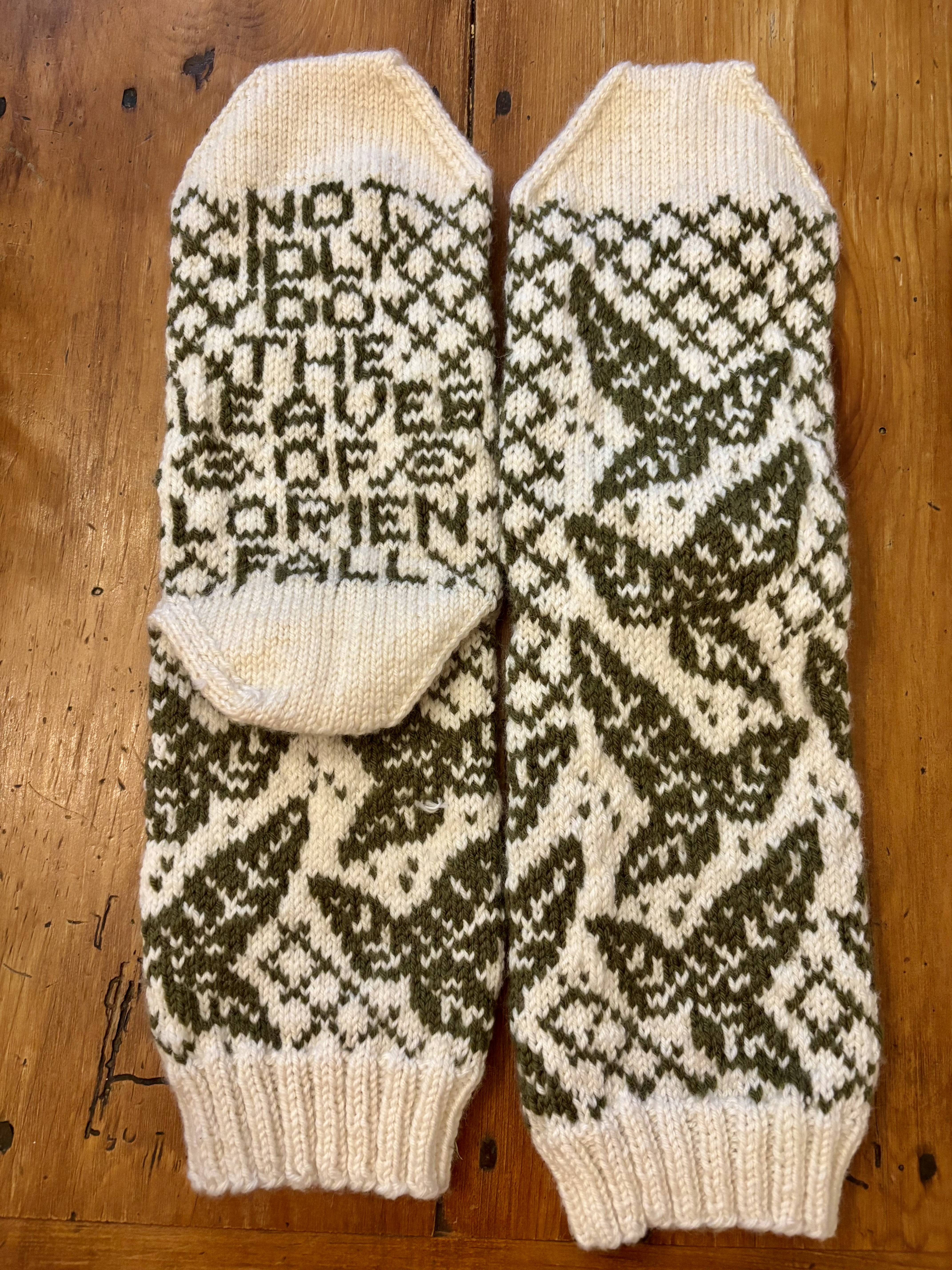
Not Idly Do the Leaves of Lórien Fall
I received a remarkable gift from my daughter recently: a pair of socks she knitted for me. Now, I realize that a pair of socks may not immediately strike you as remarkable. But these are no ordinary socks. Knitted into them are images inspired by the leaves of Lórien from J.R.R. Tolkien’s The Lord of the Rings. And woven into the pattern are words from one of my favorite little lines from Tolkien: “Not idly do the leaves of Lórien fall.”
If you know The Lord of the Rings, you may remember the scene. After the Fellowship has been broken, Merry and Pippin are captured by the Orcs. Aragorn, Legolas, and Gimli set out in pursuit, desperately trying to find some indication of where the hobbits have been taken.
Along the way, Aragorn notices something lying on the ground. It is a small green-and-silver brooch shaped like a leaf—the kind given to each member of the Fellowship when they departed Lothlórien. Pippin had deliberately torn it from his cloak and dropped it, hoping that someone following behind might see it.
Aragorn picks it up and says: “Not idly do the leaves of Lórien fall.”
He understands immediately that the brooch did not simply fall there by accident. Pippin had left it behind as a sign. Something that looked insignificant was actually pointing toward something. Something that appeared accidental had a purpose. Something small enough to be overlooked became a source of hope.
If you’ve read the books, you may know that there is another beautiful layer to Tolkien’s choice of words. The great mallorn trees of Lothlórien were unusual. Their leaves turned golden in autumn but remained on the branches through the winter. Only with the coming of spring, as new leaves began to appear, did the old golden leaves finally fall. Even the leaves of Lórien seemed to fall in their appointed season.
Aragorn’s words carry a meaning beyond the little brooch he finds lying on the ground: Not idly do the leaves of Lórien fall. Things are not always as random or as desperate as they may appear. Tolkien never reduces this to a simple formula. He leaves room for mystery, choice, suffering, evil, courage, and sacrifice. But there is an unmistakable sense throughout his world of middle-earth that there is more happening than the characters can see, that events which seem insignificant or even tragic in the moment may belong to a much larger story.
That is one of the things I love most about Tolkien. And it is also one of the things I believe most deeply about God.
The Apostle Paul writes in Romans 8:28, “And we know that for those who love God all things work together for good, for those who are called according to his purpose.”
Paul does not say that all things are good. They aren’t. There are losses we would never choose, doors we wish had remained open, relationships that break, prayers that seem unanswered, seasons we don’t understand. Things happen to us that, from where we stand, appear every bit as random as a leaf lying beside a road.
But Scripture makes an astonishing claim: God wastes nothing. He is able to take even the broken, painful, confusing pieces of our lives and weave them into purposes we cannot yet see. Joseph understood this only after years of betrayal, slavery, false accusation, and imprisonment. Looking back, he could finally say to his brothers, “You meant evil against me, but God meant it for good” (Genesis 50:20).
The evil was real. The pain was real. But neither evil nor pain got the final word. God did. Perhaps this is one way of thinking about God’s providence: Not idly do the leaves fall.
Which brings me back to my socks.
My daughter knitted these for me, and I love them. Partly because I love Tolkien. Partly because they are incredibly creative. But mostly because my daughter made them for me and I love her. Anyone who has ever knitted something this intricate knows that there is nothing accidental about it. Every stitch has a place. Every part of the pattern has to fit with what came before it and what comes after it.
If you looked at only one thread, you couldn’t possibly understand the design. You have to see the whole. And maybe that’s another reason these socks have become a little picture of providence for me. We see only the threads. God sees the whole big beautiful pattern.
We experience our lives one moment at a time: one joy, one disappointment, one answered prayer, one unexpected turn, one loss, one new beginning. And often we cannot imagine how they could possibly fit together.
But God sees what we cannot. He sees the whole pattern. That doesn’t mean every event was caused by God or that everything that happens is somehow good. Christianity never asks us to call evil good or pretend that pain is pleasant. It means something far more hopeful: nothing is beyond God’s ability to redeem.
Nothing is wasted. No suffering is meaningless in His hands. No act of faithfulness is forgotten. No prayer disappears unheard. No sacrifice made for Christ is ultimately lost. And sometimes what looks like a leaf lying unnoticed along the road turns out to be a sign that God has been at work in ways we could not yet see.
There will be parts of our stories we will probably never understand this side of eternity. For now, we see only pieces. We see individual stitches. We see fallen leaves. But one day, I believe, we will see the pattern. And perhaps we will discover that some of the moments we understood least were being woven into something far greater than we could have imagined.
So I am going to wear my Tolkien socks! And whenever I look down and see those leaves knitted into them, I hope I remember what Aragorn discovered while searching for his friends, “Not idly do the leaves of Lórien fall.” And neither, in the providence of God, are the smallest pieces of our lives ever beyond His redeeming hands.